|
 Hainault Forest Website
 |
|
Written and
Designed by © Brian Ecott |
|
FUNGI, SLIME
MOULDS, LICHENS |
|
Fungi to end of
2017
Click
Hyperlinks below to view groups |
|
Agarics |
Earthballs, Earthstars & Puffballs |
|
Amanita |
Funnels |
|
Armillaria
Honey Fungus |
Inkcaps |
|
Ascomycetes
Spore shooters |
Jelly
ears, Jellies and Brains |
|
Blewits |
Knights, Shanks and Parachutes |
|
Boletes |
Milkcaps |
|
Bonnets |
Oysters and
Oysterlings |
|
Brackets |
Parasols |
|
Brittlegills |
Roundheads |
|
Buttercaps |
Rustgills and
Scalycaps |
|
Clubs, corals
and Spindles |
Stinkhorns |
|
Crusts |
Tufts |
|
Deceivers |
Waxcaps |
|
|
|
Agarics |
|
 |
 |
|
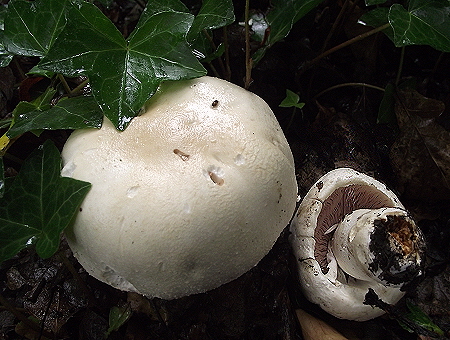
Field mushroom
Agaricus campestris on horse pasture. 22nd October 2015. Photo
© Brian Ecott |
Wood mushroom growing in
a woodland area near the lake. 6th June 2017. Photo © Brian Ecott |
|
Amanitas |
|
 |
 |
 |
|
Above: two aspects of Fly agaric
Amanita muscaria. Cap is 17cms diameter. Right: General
view of the single specimen in its surroundings. Note the silver birch
in the background. Fly agaric has a symbiotic relationship with the
Silver birch passing nutrients to the roots of the birch in return for
sugars. 14th November 2016. Inset : Pictured on 23rd November
2016 a new fruiting body is developing close to the site of the
original. Photos © Raymond Small. |
 |
 |
|
The first sighting of a Fly agaric
Amanita muscaria in 2017 was on the 25th September. Up the
footpath beyond the cottages, the fly agaric is associated with the
roots of silver birch. It has not yet appeared at other known sites.
Photo © Brian Ecott |
Fly agaric Amanita muscaria.
24th October 2015. First
one found this year. Always associated with the roots of Birch trees
growing nearby. POISONOUS. This specimen has been attacked by
slugs who have been eating large holes in it.
Photo © Brian Ecott |
|
  |
|
Fly agaric fungi on Cabin Hill, with
associated Silver birch 31.10.09 |
 |
 |
|
Tawny Grisette Amanita fulva Cabin Hill, 22nd August 2017
Photo
© Brian Ecott. |
Panther cap Amanita
pantherina in Horse pasture. DEADLY POISONOUS.
4th October 2015.
Photo © Brian Ecott |
 |
 |
|
False deathcap
Amanita citrina
in woodland on Dog Kennel Hill.
22nd September 2015.
Photo © Brian Ecott |
False death cap Amanita citrina 18th
August 2017. Photo © Brian Ecott Hainault Lodge Local Nature Reserve, |
|
Armillaria
Honey fungus |
|
 |
 |
|
Honey fungus
Armillaria mellea at base of oak in the Horse pasture
Photos © Brian Ecott. 14th October 2015. Note the brown stems and
the yellow rings.
Spreads underground by black threads aka Bootlaces. This is a
major threat to foresters |
 |
 |
|
Honey fungus
Armillaria mellea at the base of an old hawthorn. Also known as
Bootlace fungus the fungus can spread by black bootlace like
structures which can travel underground to infect other vulnerable
trees in a wide area. Hoghill. 19th October 2016. Photos © Raymond
Small. |
 |
|
|
Honey fungus aka Boot
lace fungus Armillaria mellea. The black bootlace is collections
of fungal hyphae (fungal threads) which travel through the dead
trees and soil to infect other nearby trees. Known as the
Forester's Curse. Clusters of the fruiting bodies may be found at
the foot of diseased trees.
Photo © Colin
Carron 11th September 2015 |
|
|
Ascomycetes
Spore shooters |
|
 |
 |
|
This tiny fungus on an oak log belongs
to a group of fungi called Spore shooters or Ascomycetes. This is
Purple jelly disc Ascoryne sarcoides.
Photo © Raymond Small. 15th November
2016 |
Semifree Morel fungus
Morchella semilibera 26th
April 2010 |
 |
 |
|
Candle snuff or Stags Horn Xylaria
hypoxylon on rotting wood.
Photo © Brian Ecott 19th November
2016. |
Stag's horn or Candlesnuff
fungus Xylaria hypoxylon growing on rotting stump. Common
throughout the year. Photo ©
Michael Rumble 8th
December 2014. |
 |
|
Small
orange fungus on silt removed during ditch clearance. Oak path.
Orange cup Melastiza cornubiensis. 31st October 2014.
Thanks for the
identification to local mycologist Peter Comber.
|
 |

Above: A line of eyelash fungi
Scutellinia scutellata growing on a rotting hornbeam log. It is
reported as present in the forest although this is a first for me. Found
Lambourne wood, near Spurgate.
28th March 2017. Photo © Brian Ecott
Left: Lovely close up of the Eyelash fungus
showing the brown hairs or lashes. 28th March 2017. Photo © Raymond Small. |
 |
 |
|
On cleared woodland near
Sheepwater and growing on old bramble stems is Scarlet Elfcap
Sarcoscypha austriaca,.17th
February 2017.Photo
© Brian Ecott |
 |
 |
|
Charcoal cup Peziza
echinospora near toilet block. 14th September 2012. |
Ascomycete fungus Ciboria batschiana on old acorn. 6 Oct.
2007. |
|
 |
 |
|
Dead man's fingers Xylaria
polymorpha Photo © Francis Castro
21st October 2012
Hainault Lodge Local Nature Reserve
|
Dead moll's fingers Xylaria longipes Photo ©
Francis Castro
21st October 2012 Hainault Lodge Local Nature Reserve |
|
 |
|
|
Hare's ear fungus Otidea onotica
in secondary woodland at back of lake.
Not common in Hainault.1st
October 2015. Photo © Brian Ecott |
|
 |
 |
|
White saddle Helvella crispa Found along the ride edges
on Cabin Hill.
22nd October 2014. |
Helvella atra
Photo: 28th October 2006
Thanks to Thomas
Bardorf (Austrian Mycological Society for the correct
identification of this specimen. |

Coral spot Nectria
cinnabarina. Appears on small cut branches.
Photo
©
Colin Carron
14th October 2014 |
 |
 |
|
These pieces of fallen oak found in the secondary woodland, has a
fungus in it called Green Elfcap Chlorociboria aeruginascens
which sometimes has tiny fruiting bodies, but generally as here only
the fungal stained wood is found, Used in Marquetry, found in
Tunbridgeware antiques. |
 |
 |
|
Oak pin Cudoniella acicularis in furrows in tree bark. 1st
November 2015. Amongst aspens near lake. Photo
©
Brian Ecott |
Beech woodwart
Hypoxylon fragiforme on fallen beech. 28th September 2015. Photo
© Brian Ecott. |
 |

|
|
Cramp balls aka King
Alfred Cakes. Hard cinder-like fungi on fallen branch - probably ash
on which it is normally found. A section through the fungus shows
concentric growth rings hence its specific name Daldinia
concentrica. 10th February 2015. |
|
 |
 |
|
King Alfred's cake halved to show
concentric rings. Photo: 30th March 2009. |
|
  |
|
|
The Fungus on the grass stem
is Epichloë typhina and it has a
symbiotic or
beneficial relationship with the grass. Close up (right
above).
Photo © Michael Rumble 23rd July 2014.
|
|
|
|
|
|
Blewits |
 |
|
|
Wood blewits 23rd October 2008 |
|
 |
|
This large grassland species is Field
blewit Lepista personata, and it has a cap diameter of 13 cms.
The stem is lilac colour. Found on Lord's Pond field near the Country
Park main entrance. Photo © Brian Ecott. 27th October 2017. |
|
 |
 |
|
The
rare fungus Rosegill Volvariella bombycina found beneath an ancient
field maple in the Angel Car Park Photos: 16th August 2006. |
|
Boletes |
|
 |
 |
|
Red Cracking bolete
Xerocomellus chrysenteron
3rd August 2017 |
Young Cep aka Penny Bun
Boletus edulis 3rd August 2017 |
|
 |

|
|
The cap and underside of the Weeping bolete
Suillus granulatus. Boletes have pores underneath instead of gills.
All Saint's Chigwell Row.
Photos © Peter Comber 5th Nov. 2015 |
|
 |
|
|
Yellow cracking bolete Boletus submentosus. Common
in the woodland areas. 9th August 2017. Photo © Brian Ecott |
|
|
Bonnets |
|
 |
 |
Angel's bonnet Mycena
arcangeliana on rotten trunk 22nd October 2016.
Photo © Brian Ecott |
 |
|
Angels bonnets Mycena
arcangeliana on oak stump, Chigwell Row Common.
26th October 2013. |
Clustered bonnet Mycena
inclinata in hollow oak stump. 21st August 2012.
Photo
©
Len Ratcliff |
|
 |
|
Angels bonnets Photo
© Brian Ecott 8th October 2015. Thanks to local mycologist Peter
Comber for the identification. |
 |
|
|
|
|
 |
 |
|
Nitrous bonnet Mycena
leptocephala. Common in short grassland by the lake. 1st
November 2015. Photo © Brian Ecott |
Brownedge bonnet
Mycena olivaceomarginata. In short grassland by lake.
Cap is about the same
size of a 1p.coin. 1st November 2015 in short grassland near
the lake. Photo
©
Brian Ecott. |
  |
|
Pink bonnet
Mycena pura, Hainault Lodge Nature Reserve 26th October
2004 |
Pink bonnet
Mycena pura 25th October 2014 |
|
Brackets |
|
 |
 |
|
Turkey tail Trametes versicolor
A variable coloured bracket fungus here with rich colours on old
wood.. Photo © Brian Ecott 13th November 2016. |
Turkey tail brackets
Trametes versicolor on fallen beech. 19th October 2016.
Photo © Raymond
Small |
|
 |
 |
|
Turkey tail
Trametes versicolor.
A small bracket on a fallen birch tree. Open plain near
Romford Gate. 20th October 2015. Photo © Brian Ecott |
Turkey tail
Trametes versicolor.
29th November 2007 |
|
 |

|
|
Birch polypore aka
Razor strop fungus Piptoporus betulinus. When it appears on
birch, the tree is dead or dying. Here the bracket is
growing from an upright tree, and above right is an old decaying
bracket.
20th October 2015.
Photo © Colin Carron |
Richard with Birch bracket Piptoporus betulinus.
It measured 36mm in width 23rd October 2008 |
|
 |
 |
|
Razor strop
fungus or Birch bracket Piptoporus betulinus
is found on Birch all year round. 11th October 2014. |
Postia ptychogaster
was found by Sarah White on a wooden fence buttress presumably pine.
It was said by Mary Smith of the Essex Field Club to have been
recorded only once in Essex on
02/09/1952, in Birchanger Wood near Bishops Stortford when It was
found by E Groves, and identified by J B Evans.
Peter Comber
photographed several on the 12th November 2014. |
|
 |

|
|
Bracket fungus Chondostereum purpureum on hawthorn behind the
café 30th December 2016 and on rotting log near
lake 9th Jan '17 Photos © Brian Ecott |
|
 |
 |
|
Artist's bracket Ganoderma
applanatum
on rotten trunk near Peter's gate.
9th October 2016 Photo ©
Raymond Small |
Artist bracket
fungus
Ganoderma applanatum on beech bole. Dog kennel Hill. 18th
September 2014. |
 |
|
Dryad's saddle
Polyporus squamosus
on willow stump by the Lake.
5th
June 2017 Photo
© Brian Ecott. |
|
 |
|
Beef steak fungus Fistulina
hepatica on oak tree base. 15th August 2017 Photo
© Brian Ecott
|
 |
 |
|
Conifer Mazegill
Gloeophyllum sepiarium on a Woodland Trust notice board near The
Camelot. |
 |
|
Above and right: The rare
Conifer mazegill
Gloeophyllum sepiarium. It is occurring
on most of the Woodland Trust notice boards and was probably
imported on the wooden boards when purchased. Present on a few
boards in 2012 26th October 2013. |
|
 |
 |
|
Shaggy bracket Inonotus
hispidus on Ash tree near café 15th August 2012.
Identified with thanks by Peter Comber who has not recorded this
before in Hainault Forest. |
The bracket
Ganoderma pfeifferi on beech stump on Dog Kennel Hill.,
October 2006 |
|
 |
|
|
Giant polypore
Meripilus giganteus growing at the base of a beech stump 29th
September 2013 ©
Brian Ecott |
|
 |
|
|
Willow
bracket Phellinus igniarius on old willow on former farm pond,
alongside 2nd car park, 6th February 2017. Photo
© Brian Ecott. |
|
 |
|
Lumpy bracket
Trametes gibbosa on cut Hornbeam stump. Cavills walk, Lambourne
Wood. 24th January 2017. Photo © Brian Ecott. |
 |
|
Raymond Small has captured the hairy
surface of this fungus known as the Hairy Curtain Crust Stereum
hirsutum on an old log.
1st February 2017. Photo © Raymond Small. |
 |
|
Hairy curtain crust
Stereum hirsutum was often found on tree stumps and logs. Jan
2009 |
 |
 |
|
Zoned rosette Podoscypha multizonata an early autumn species
of fungus found in the secondary woodland on Cabin Hill. 7th Sept.
2010. |
The rare Podoscypha
multizonata on Cabin Hill 2nd October 2005 |
 |
 |
|
Zoned rosette
Podoscypha multizonata.
Thin leathery lobes arising from a short very stout stem. Usually
has light and dark bands. Occasionally turns up in the forest.
Found this time in the horse pasture. 4th October 2015.
Photo © Brian Ecott |
 |
|
Found on a fallen branch
is the fungus Radulomyces molaris syn. Cerocorticium
molare 15th November 2014. Scale x1.5. Identified with thanks to
Peter Comber who states that this is an old specimen. Younger
specimens are lighter in colour. The specific name molare/molaris
refers to the teeth like shape of the fruiting body. Said to be rare. |
|
 |
|
|
Tooth fungus Radulomyces molaris
syn. Cerocorticium molare on fallen twig on Dog Kennel
Hill woodland. 8th November 2015. Status occasional. Found last
year.
Photo
©
Brian Ecott |
|
 |
 |
|
Upper and underside
of a tiny Split gill fungus Schizophyllum commune on cut oak
log. Photos © Raymond Small 7th November 2016. |
 |
|
Poplar
bells Schizophyllum amplum 9th January 2017 on the underside of a
rotting branch of Grey poplar near the lake. |
|
 |
|
|
Raymond Small made this
unusual discovery of Poplar Bells growing on Willow 17th January 2017 by
the Lake. Photo © Brian Ecott |
|
|
Brittlegills |
|
 |
|
|
Powdery brittlegill Russula parazurea. All Saint's Chigwell
Row.
Photo © Peter Comber 5th Nov. 2015 |
|
|
Buttercaps |
|
|
 |
 |
|
Butter cap Collybia butyracea.
Cap feels greasy. Photo © Raymond Small.
15th November 2015.
|
Buttercap Collybia butyracea
Cap has a buttery feel 27th October 2014. |
|
 |
|
|
Buttercap Collybia
butyracea. Distinctive, cap feels buttery. Found in
leaf litter in the wooded areas. 9th October 2015. Photo © Brian Ecott. |
|
|
Clubs,
Corals and Spindles |
|
 |
 |
|
Apricot club Clavulinopsis luteoalba
in short grassland in the horse pasture.
Picture © Raymond Small. 15th November
2016. |
Slender club fungus
Macrotyphula juncea. On twigs and leaves among aspen near lake
inflow. 1st November 2015. Photo
©
Brian Ecott. |
 |
 |
|
Golden spindles Clavulinopsis
fusiformis have been very abundant over all the short
grassland this year. 12th November 2015.
Photo
© Brian Ecott. |
Yellow club
Clavulinopsis helvola in short grassland on Hoghill.
9th October 2015, Photo © Brian Ecott |
 |
 |
|
White Coral Clavulina coralloides.
Photo © Peter Comber 5th Nov. 2015 (Note the pine needles in all the
churchyard pictures) |
Meadow coral Clavulinopsis
corniculata near the lake outfall.
12th November 2015.
Photo
© Brian Ecott. |
|
Crusts |
|
 |
 |
|
Split porecrust
Schizopora paradoxa - a common crust on fallen timber all year.
Photo © Brian Ecott 6th December 2016 |
White rot Phellinus contiguus
spotted on an oak branch by Raymond Small on 19th January 2017. The larger
patch was 3cm across. Thanks to Tony of NaturePlus at the
Natural History Museum for the ID.. Scan © Brian Ecott. |
|
 |
 |
|
A white crust on a fallen
log. Close up showing pores. Identified by local mycologist Peter
Comber as Trechispora mollusca.
4th January 2015 |
|
 |
|
 |
|
Bleeding oak crust fungus Stereum
gausapatum on oak log. The lower picture shows "blood" exuding from
the fungus when cut with a penknife.
Photos © Raymond Small 7th January
2017..
|
|
Deceivers |
|
|
 |
|
The
Deceiver Laccaria laccata plentiful in grassland and wooded
areas. On Hoghill, 5th November 2014 Identity
confirmed by Peter Comber. |
 |
 |
|
Amethyst deceiver
in the Horse pasture. Gills, cap and stem purple colour, although when dry
the cap may be light brown.14th October 2015.
Photo © Brian Ecott. |
The Deceiver Laccaria laccata. In
the secondary woodland near the lake. The fibrous stem and the unequal
gills help identify this species. 30th January '17. Photo © Brian Ecott |
|
Earthballs,
Earthstars and Puffballs |
|
 |
 |
|
Common earthball Scleroderma citrinum
in Lambourne Wood 12th August 2017 Photo © Brian Ecott |
Common earthball
Scleroderma citrinum. Unlike the puffballs which have a thin
skin and liberate spores when hit by raindrops The Earthballs
contain a mass of black spores which are liberated by breakdown of
the fungus.
Hence sclero=hard
derma=skin. Photo
©
Colin Carron. February
2015. |
|
 |
 |
|
Leopard earthball
Scleroderma areolatum. 3cm across. On bare ground
alongside path. Not common in Hainault 1st October 2015.
Photo © Brian Ecott |
Scaly Earthball Scleroderma verrucosum
in woodland. Photo © Brian Ecott. |
 |
|
Common puffballs Lycoperdon
perlatum 12th September 2011 |
 |
|
|
Common puffballs
Lycoperdon perlatum in horse pasture
19th October 2015 Photo © Brian Ecott |
|
  |
|
Common puffball Lycoperdon perlatum
22nd October 2014 is a fleshy fungus when young. It gradually
becomes a bag of millions of brown spores which are liberated if a
raindrop or object falls on the top of the fungus. This is illustrated
right by Peter Comber in an old photograph of his.
Spore discharge. Photo
©
Peter Comber 2003. |
|
 |
|
Giant puffball Calvatia gigantea
on Dog Kennel Hill. During the war it was known as Hitler's secret
weapon. Said to have been reported to the police when found. 21st
September 2015 Photo © Brian Ecott |
|
 |
 |
|
Giant puffball Calvatia gigantea.
About the size and weight of a cricket ball. Can be very much
larger. This one has been eaten into by slugs. 25th October 2014 Photo
©
Colin Carron. |
Three
Giant puffballs Calvatia gigantea.
These were each the size of a match football. It has been said
that during WW2 they were thought to be Hitler's secret weapon. Police
were notified of their presence in grassland. On Hoghill path
alongside the golf course. 12th November 2014.
©
Peter Comber |
|
 |
|
EARTH STAR
Geastrum triplex at Hainault Lodge Reserve 26th October 2004 |
|
 |
|
Three Earthstars among Horse
Chestnut leaves, Hainault Lodge Nature Reserve. 26th October 2004 |
|
Funnels |
|
 |
 |
|
One of several Trooping funnels
Clitocybe geotropa Photo © Raymond Small.
13th November 2016. |
Trooping funnel Clitocybe
geotropa. Small funnel shape, cream cap, gills down stem
(decurrent), stem broadens to the base. In secondary woodland
near Headland path. Compare with below. 24th October 2015.
Photo © Brian Ecott.
|
 |
|
Young Trooping funnel
Clitocybe geotropa found along the old horseride 11th October
2014 |
 |
|
Trooping funnels
Clitocybe geotropa as seen from the 2nd car park through the
tree line towards the café,
8th November 2015. Photo © Michael Rumble |
 |
|
Trooping funnel Clitocybe
geotropa, trooping through the brambles,
Largest cap in troop was 21cms diameter.
24th October 2015. Photo © Brian Ecott.
|
|
 |
 |
|
Clouded funnel or Clouded agaric
Clitocybe nebularis As its specific name suggests the cap is a
cloudy-grey Photos © Raymond Small 23rd November 2016. |
|
 |
|
|
Clouded funnel or agaric
Clitocybe nebularis, common and often in large rings in the
wooded areas, 6th November 2014, |
|
|
 |
|
Clouded funnel or agaric
Clitocybe nebularis. A large
funnel shaped cap with gills down part of the stem (decurrent).
10cms diameter. Found in bramble and scrub in the secondary
woodland near the lake. May also be found in large rings. 16th
October 2015. Photo © Brian Ecott. |
|
 |
|
Part of a Clouded
agaric ring on Cabin Plain. Photo: 1st November 2005 |
 
Illustrated left:
Clitocybe americana a Red Data
species.
22nd October 2009
Photos © Peter Comber |
|
|
|
|
|
|
Inkcaps |
|
|
 |
 |
|
Pleated inkcap Coprinus plicatilis
among Millfoil
in short grassland.
21st October 2016. Photo © Raymond
Small. |
Mature pleated inkcap Coprinus
plicatilis.
They have opened up and the gills are blackening. 23rd October
2016. Photo © Raymond Small |
|
One of a genera of
short lived fungi which appear, mature and dissolve in a black inky
mass (deliquescence) as starting in the picture above right. |
|
 |
 |
|
Pleated inkcap
Coprinus plicatilis 21st September 2015 in woodland at
back of café.
21st September 2015. Photo ©
Brian Ecott |
Common inkcaps
Coprinus atramentarius growing on dung 28th September 2013
©
Michael Rumble. |
 |
 |
|
Lawyer's wig or Shaggy inkcap
Coprinus comatus on Woodhenge mound. 20th November 2015. Photo
© Michael Rumble. |
|
 |
|
Glistening
inkcap Coprinus micaceus on rotten wood. The cap glistens like mica
- hence the name. Photo ©
Colin Carron 5th
September 2014 |
|
Jelly ears,
Brains and Jellies |
|
 |
|
Jelly ear Auricularia
auricula-judae. Commonly found on Elder in the forest. Photo
© Brian Ecott 8th January 2016 |
|
 |
 |
|
Jelly ear Auricularia auricula-judae
on rotting wood. Commonly found on Elder. Photo © Raymond Small. 13th
November 2016. |
Leafy Brain fungus Tremella
foliacea Headland Path 28th November 2012
Identified as rare by local
mycologist Peter Comber. |
|
 |
 |
|
Yellow brain fungus Tremella mesenterica on old willow
twig.
Photo: 9th March. |
Yellow brain fungus Tremella mesenterica
on old rose stem. 23rd January '17. Photo © Brian Ecott |
 |
 |
|
Yellow Brain fungus
Tremella mesenterica on dead branch near the lake. The lobes
are yellow-orange, soft and jelly-like. 4th January 2015. |
By contrast to the
previous picture taken last year, here is the same species which has
dried, aged, become wrinkled and turned a deeper orange. Thanks to
Mary Smith, Sec. Essex Field Club for her identification and comments.
Photo © Brian Ecott 13th March 2016. |
 |
 |
|
Witches butter Exidia glandulosa on
oak branch, Hainault Lodge Local Nature Reserve. 27th January 2017.
Photo © Brian Ecott. |
Witches butter Exidia
glandulosa on fallen branch. The fungus is covered with a thin
layer of ice. 4th January 2015. |
 |
|
|
Strong winds in recent weeks have
brought down small branches from oaks. Witches butter Exidia
glandulosa is a commonly found jelly fungus on these branches.
Jan 2009. |
|
 |
|
|
White brain Exidia
thuretiana is a tiny (1 cm) jelly-like fungus on rotten beech in the
woodland behind the café 31st December 2016
© Brian Ecott |
|
|
 |
|
White Brain fungus Exidia
thuretiana on fallen hornbeam. Photo © Daniel Britton, Latchford
Meadow 25th March 2013. Identified by Peter Comber. |
 |
|
|
Common Jellyspot
Dacrymyces stillatus on rotting stump, back of lake, Photo ©
Raymond Small. 2nd February 2017. |
|
|
Knights,
Shanks and Parachutes |
|
|
 |
|
Sulphur
Knight Tricholoma sulphureum in mixed woodland Cabin Hill
26th October 2013 Photo ©
Ron Andrews |
|
 |
 |
|
Yellowing Knight Tricholoma
scalpturatum
in grassland alongside the former changing rooms. 12th October
2015. Photo © Brian Ecott. |
Yellowing Knight (fresh specimen)
on grassland towards the lake.
23rd October 2015 Photo
© Brian Ecott |
 |
|
| Velvet shank
Flammulina velutipes on old willow on former farm pond,
alongside 2nd car park, 6th February 2017. Photo
© Raymond Small |
|
 |
|
Porcelain fungi Oudemansiella mucida
on fallen beech on Hog Hill.. Discovered and photographed © by Raymond
Small. 17th October 2016. Cap 2-8cms across, A ring on the stem,
slimy often dripping, delicate. I have seen this in Epping Forest but
this is a first for me in Hainault. |
 |
|
|
Young developing Porcelain fungi
Oudemansiella mucida as above.
Photo © Raymond Small |
|
  |
|
|
Twig parachute Marasmiellus
ramealis. Very tiny fungus growing on a dried blackberry stem.
Along Retreat path. 21st October 2015. Photo © Brian Ecott |
|
|
Milkcaps |
|
 |
 |
|
Milk cap
shedding milky substance when damaged. |
Fishy milkcap Lactarius volemus. The milk seen in the picture
smells fishy.
All Saint's Chigwell Row. Photo ©
Peter Comber 5th Nov. 2015 |
 |
|
|
Birch milkcap Lactarius
tabidus 5th November 2014 Thanks to Peter Comber for the
identification |
|
|
Oysters
and Oysterlings |
|
   |
 ▲
Left a scan of some tiny gilled fungi (approx 1cm across) on a
log. Alongside two close up photographs taken by Michael Rumble on
4th January 2016. Thanks to Mary Smith Secretary and Mycologist,
Essex Field Club who kindly identified it as Smoked oysterling
or Black jelly oyster
Resupinatus applicatus. ▲
Left a scan of some tiny gilled fungi (approx 1cm across) on a
log. Alongside two close up photographs taken by Michael Rumble on
4th January 2016. Thanks to Mary Smith Secretary and Mycologist,
Essex Field Club who kindly identified it as Smoked oysterling
or Black jelly oyster
Resupinatus applicatus. |
 |
 |
|
Flat oysterling Crepidotus applanatus
on rotting elder log. 1-2cms across. Underside reveals split gills and
a rudimentary stem. 3rd January 2017
Photos © Brian
Ecott |
|
 |
 |
|
Some Oyster mushrooms Pleurotus
ostreatus were found on a fallen beech
Jan 2009
|
Oyster mushroom
Pleurotus ostreatus on fallen beech. 7th August 2011 |
|
 |
 |
|
Not very fresh
Oyster mushroom Pleurotus ostreatus on tree stump in horse
pasture. Right - Showing underside. 23rd September 2015.
Photos
© Brian Ecott |
|
Parasols |
|
|
 |
 |
|
Field parasol
Macrolepiota procera 12th September 2011 |
|
 |
|
  There has been an
abundance of Parasol mushrooms Macrolepiota procera in the
horse field this year. (2013) Some of the caps had a diameter of 25cms, and
they are very tall and easily knocked over. There is a moveable ring
on the stem and the stems base is speckled. Many fungi grow in rings,
some many metres across and visible in ariel surveys. Below shows a
ring centered on a patch of nettles . The ring typically expands
outwards over the years as nutrients are used up. Said to be edible
and excellent. Photos left ©
Michael Rumble and
above Brian Ecott. 29th Sept. 2013. There has been an
abundance of Parasol mushrooms Macrolepiota procera in the
horse field this year. (2013) Some of the caps had a diameter of 25cms, and
they are very tall and easily knocked over. There is a moveable ring
on the stem and the stems base is speckled. Many fungi grow in rings,
some many metres across and visible in ariel surveys. Below shows a
ring centered on a patch of nettles . The ring typically expands
outwards over the years as nutrients are used up. Said to be edible
and excellent. Photos left ©
Michael Rumble and
above Brian Ecott. 29th Sept. 2013. |
|
 |
 |
|
Parasol mushroom Macrolepiota
procera in the horse pasture. The cap diameter was 18cms. Few and
far between this year and smaller cap sizes.
Photo © Raymond Small. 15th November
2015. |
Parasol
mushroom Macrolepiota rhacodes. Abundant this year on Dog
kennel Hill and horse field. Large ring on stem, moveable. Photos
©
Michael Rumble 8th
September 2014. |
|
 |
 |
|
Parasol mushroom Macrolepiota
procera. Incredible size!
Cap 27cms.diameter, Stem height
38cms. In horse pasture.
Photo Michael Rumble
23rd September 2015. Pictured with Brandy V.
|
Parasol mushroom Macrolepiota
procera.25th September 2015 in the horse pasture. Shows a ring
which is movable on the stem. Photo © Brian
Ecott |
|
 |
|
View of Lepiota rhacodes var bohemica showing the large ring
and the stipe which is bulbous at the base. 28th October 2014. |
 |
 |
Two pictures above and
right show Lepiota rhacodes var bohemica, identified by
local mycologist Peter Comber. This species grows in the lower slopes
of woodland on Hoghill mainly among bramble. They can often be found
tracing out large rings. Cap 10 cms and stem or stipe 9 cms.
Photos
©
Colin Carron 23rd
October 2014. |
|
Roundheads |
|

|
 |
|
Redlead Roundhead
Stropharia aurantiaca (Leratiomyces ceres)
25th October 2014
with thanks to Peter Comber for its identification. |
Dung roundhead Stropharia
semiglobata. Found in the horse meadow.
3rd November 2015.
Photo
© Michael Rumble |
|
Rustgills
and Scalycaps |
|
 |
|
Spectacular rustgill aka Big Jim
Gymnopilus junonius in the secondary woodland near Peter's
Gate. It is growing on a buried tree root and is a young developing
fungus. Photo © Brian Ecott 9th November 2016. |
|
 |
|
|
Big Jim Gymnopilus junonius as
above now with an expanding cap. Peter's gate. 22nd
November 2016 Photo © Raymond Small. |
|
|
 |
|
Spectacular rustgill aka Big Jim Gymnopilus junonius on tree roots in secondary woodland
near Peter's Gate. 20th October 2015. Photo © Brian Ecott |
|
 |
 Peter Comber has captured these
same Spectacular rustgills 8 days later than in my original
photograph above top. POISONOUS.
28th October 2015. Photos ©
Peter Comber |
|
 |
 |
|
Poplar
scalycap Pholiota populnea emerging from the base of a
felled Poplar tree 24th October and 29th October 2013 on Hog Hill.
|
|
Stinkhorns |
 |
|
|
Stinkhorn fungus
Phallus impudicus with developing egg. 5th August 2011 |
|
   |
| On
30th October 2010 a Stinkhorn egg Phallus
impudicus was found and cut in half to show the mycelium and
developing stinkhorn. The outer layer is a jelly like substance, the
middle layer is a greeny-brown jelly containing a spore mass and the inner
layer looks like polystyrene which will eventually expand to produce the
mature stinkhorns illustrated right. Flies are attracted to the stinkhorn
because of its pungent smell and eat the
sticky green spores which get transferred elsewhere. When all the spores
are eaten the top of the stinkhorn is white. Photo © Peter Comber. |
|
Tufts |
|
|
 |

Sulphur tuft Hypholoma
fasciculare on rotting stump in Lambourne wood.
30th September 2015. Photo © Brian
Ecott

Possible Hypholoma species -
awaiting identity. On rotting log in the farm (old camp site)
yard. 8th November 2015. Photo © Michael Rumble. |
|
Sulphur tuft Hypholoma fasciculare
also on rotting wood.
Photo © Raymond Small 22nd
November 2016. |
 |
|
Sulphur tuft
Hypholoma fasciculare growing on a rotting tree stump. Plentiful
this year. 5th November 2014. |
 |
|
Sulphur tuft Hypholoma
fasciculare on rotting stump. Dog kennel Hill.
18th September 2014. |
| a
a
a
a
a
a |
|
Waxcaps |
|
   |
| 1. Parrot wax cap Hygrocybe
psittacina Photo © Ron Andrews 28th October 2012.
2.
Mature Parrot waxcap
Hygrocybe psittacina
still retaining some green on cap and stem. In short grassland on Hoghill.
Good distribution. 9th October 2015. 3.Young Parrot waxcaps
Hygrocybe psittacina, short grassland opposite Foxburrows
cottages 17th November 2014. Photo
©
Michael Rumble
|
|
 |
|
|
Parrot Wax Caps
Hygrocybe psittacina in grassland on Hog Hill Photo; 28th Oct.
06. |
|
 |
 |
|
Parrot waxcaps showing
later development and the gradual loss of the green colour to
yellowish. Tip of cap pink. Hoghill grassland 18th November
2014. |
|
 |
 |
|
Butter Waxcap Hygrocybe
ceracea Short grassland on Hoghill. Thanks to local mycologist
Peter Comber for the identification. 20th November 2014. |
Meadow waxcap Hygrocybe
pratensis on short grassland on Hoghill.
3rd November 2015.
Photo
© Brian Ecott |
|
 |
  |
|
Blushing waxcap
Hygrocybe
ovina. The
gills seem to have a reddish bruised area. Plentiful
in groups in short grassland on Hoghill. 28th October 2015.
Photos © Brian Ecott
|
1.
Snowy waxcap
Hygrocybe virginea. In short
grassland in horse pasture.
Several present.
22nd October 2015.
2. Scarlet Waxcap -
Hygrocybe
coccinea.
The
gills have a decurrent tooth where they join the stem.
In short
grassland on Hoghill. Uncommon. 27th October 2015.
|