|
Local Windmills
by Raymond Small and Elaine Wiltshire
 |
|
'View from Chigwell Row' from
Lithograph printed in 1805 by illustrator P.J. De Loutherbourg
|
Chigwell with its spectacular view
overlooking Hainault Forest became a popular destination for artists.
There were two windmills in Chigwell, one stood near Vicarage Lane and the
other near Fencepiece Road. From their prominent positions the windmills
could be seen breaking the skyline over twenty miles away.
Windmills were one of the earliest inventions to harness energy by using
the forces of nature. They existed before the 12th century. Popularity
increased and it became rare for a village not to have one. Early mills in
England were usually owned by the Lord of the Manor, but by the 18th
century nearly 200 were in private ownership throughout Essex. They were
normally placed on high ground to take full advantage of the wind.
Initially windmills were used for milling grain for food production. Later
they pumped water and produced electricity.
It can be difficult to determine the age of a mill.
Construction records were rarely kept. On occasion mills got blown down or
caught fire. When this occurred another mill often got erected in the same
position using timber salvaged from the debris of the previous mill. A
date carved on a beam of an old mill could later appear in a newer mill.
This means that the discovery of a date in a mill does not necessarily
reflect the true age of the building. Likewise, windmills on maps only
indicate that a mill existed when the map was drawn. A windmill shown in
the same position a few years later may not be the same one
|
WINDMILL TYPES |
|
 |
POST
MILLS
were common in West Essex and were probably the earliest type in
Britain. The main structure balanced on a large upright post and this
enabled the mill to be turned manually into the wind. Later post mills
sometimes had a fantail fitted near the base to make turning easier.
Located at: Chigwell, Chigwell Row, Chadwell Heath, Hornchurch and
Romford.
Old post mills were particularly susceptible to the threat of fire. In
strong winds it became necessary to shorten the canvas, sail by sail,
otherwise the wooden head-wheel used for braking overheated with
friction and burst into flames. A fire could also start if the hopper
ran empty and the stones rubbed together causing sparks. |
|
 |
SMOCK MILLS had a
moveable cap with a fantail which turned the sails to face the wind.
The brake that stopped the sails turning did not prevent the fantail
operating – this was essential because wind blowing from the wrong
side could cause enormous damage. If a strong gust caught the sails
from behind it was possible that they would be blown off. Smock mills
usually had six or eight sloping, weather-boarded sides and the shape
resembled smocks once worn by farmers. Located at: Barking, Mark's
Gate and Upminster.
Left: Wellington mill, Barking |
|
 |
TOWER MILLS were usually
cylindrical and built from brick or stone. Like smock mills, the main
structure didn't move and because less machinery was needed this gave
extra storage room. The availability of timber from the forest is
probably the reason none were built near Hainault, although tower
mills existed in Essex and one still stands in Thaxsted.
Photo © Elaine Wiltshire
2016
|
MILLERS
Millers
were highly respected professionals. With large stocks of ready flour in
storage the miller could control prices. During windless periods the price
of flour increased. When corn saturated the market the miller would buy
large quantities cheaply for later use. Village life revolved around the
mill. Before mass production of bread nearly every wife bought flour to
bake her own. Ground grist was also essential for feeding livestock. If a
miller wanted to keep his customers he had grind their corn as soon as
possible. He depended on the wind and worked day and night when it blew.
Apprentices were hard to recruit because of a preference for regular hours
and Sundays off.
Some millers became very wealthy.
In the Middle Ages, anecdotes were common about how much grain the miller
would keep for himself when people took their bags of corn for grinding,
this became known as the 'Miller's Toll'. If a miller got invited to the
Manor or Court he might dust himself down with flour before going for the
sake of appearances. Millers were privileged members of manorial estates
and regulations were needed to keep them taking full advantage of their
position. They were forbidden from keeping livestock in case their animals
were fed illicit grain. If proved a miller had stolen, there was the
threat of the pillory and the hurdle. The hurdle was a piece of fencing
made from thin branches. The prisoner got tied to this and dragged behind
a horse to a place of execution, where he was hung, drawn and quartered.
To stop body parts decomposing too quickly they were parboiled and then
put on public display as a grim warning to others.
SAILS
In medieval times ladder type sails had cloth wound in and out. Later,
sails were spread over a lattice framework. By varying the amount of cloth
being spread the miller could set the sails according to the wind
available and power required. Wooden slats replaced cloth in colder
climates because they were easier to handle in freezing conditions. During
the 18th century sails were invented that automatically adjusted to the
wind speed without the need for intervention by the miller.
 |
MILLSTONES
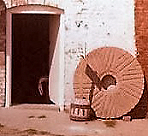
Two millstones were used
for grinding. Grain fell from a feeding tube into the eye of a runner
stone spinning above a bed stone. Sails speeding up made the feeding
tube vibrate faster and this caused grain to drop quicker. The runner
stone pressed the crushed meal against furrows cut in the bed stone
and this forced the meal out at the edges where it dropped down a
chute into collection bags below. The miller tested for coarseness by
running fingers through the meal and adjusted the pressure on the
stones if it became necessary. Sometimes a device known as a
'governor' was fitted and this used centrifugal force to keep the gap
between the stones constant. Governors prevented stones rubbing
together and starting fires when the hopper ran empty. With a steady
wind up to 800 pounds of flour could be produced in an hour.
|
FLOUR, SEMOLINA OR BRAN?
A rotating drum sieved the wholemeal to separate it into flour, semolina
and bran. The drum had sides made with different meshes. White flour
passed through the finest mesh, semolina fell through coarser mesh and by
the end only bran remained.
MAINTENANCE
Every morning the wooden bearings got greased with animal fat to keep
things running smoothly. Cogs were given a regular application of bees
wax.
 |
Millstones became
inefficient when they wore down. A process known as 'stone dressing'
kept them in working order. This required the stones to be separated,
not an easy job because a runner stone weighed half a ton. Lifting the
runner stone slightly with a crowbar enabled wooden wedges to be
inserted and this created a gap large enough to allow timber rails
through. The rails were there to guide the stone as it got flipped. If
the stone fell or rolled it would cause huge damage so great care was
taken. A hoist threaded through the stone's eye lifted the stone onto
its edge. A wooden lever then tipped the stone past its balance point
so it could be gently laid flat. With the rails prized off and working
surfaces exposed both stones were now ready for restoration work to
begin. |
|
The surface of a flat staff covered in
food-safe paint (raddle) got slide across the stones and this marked the
high spots that were then chipped away with a double-headed cold-chisel
called a mill bill. This process continued until a perfectly flat surface
existed about six inches wide around the periphery of the stone with a
slightly relieved centre area. The area near the eye on the runner stone
got taken down a bit further to form a 'swallow'. The whole process of
facing the stones could take one person a few days to complete.
The furrows now needed to be deepened to compensate for the amount taken
off. This required more chipping with the bill and needed greater accuracy
than the facing process. Depending on the state of the stones this could
take as little as a day, but sometimes much longer. 'Stitching' followed.
This entailed cutting fine lines in the flat surfaces between the furrows.
Each stitch only needed a single blow, so as long as the bill was kept
sharp, this job only took an hour or two. White flour required finer
stitching. Afterwards, a handful of grain got spread over the bed stone to
act as a lubricant before replacing the runner stone. The first few sacks
of meal from the newly dressed stones would be fed to the animals as grit
might be present.
An experienced stone dresser would
get tiny steel splinters from the mill bill embedded in his skin. To check
an unknown stone dresser had the required skills, it became common for the
miller to ask the dresser to 'show his steel' before allowing him to work
on the valuable stones.
|
MILLWRIGHTS
Millwrights were multi-skilled engineers that designed and built
windmills. During construction cast-iron fittings weighing two tons were
lifted to the top of the mill without the help of cranes. Forces exerted
by turning sails and the millstone's weight put a lot of stress on the
buildings so knowledge of materials was vitally important. Carpentry
skills enabled the millwright to set out and cut tenons on wooden
cog-wheels, in addition he needed to know about founding iron. Each
millwright had his own style and no two mills were ever the same. Mills
were held in great affection by their designers. The job carried risk and
there were instances of millwrights being crushed to death. The job didn't
pay particularly well. Millwrights often had no transport and could cover
a 10 mile radius carrying heavy tools on foot.
CHIGWELL
|
The
earliest mention of a windmill in Chigwell is 1318. |
|
 |
MOUNTPLEASANT MILL
Mountpleasant Windmill appeared soon after 1809 when Matthias Davey
arrived from Cheshunt to take over a dwelling house, outbuildings and land
in Chigwell. John Gleed bought the mill after Davey went bankrupt four
years later. Gleed employed a Norfolk miller named Robert Self. Gleed
passed away in 1827 and the property got placed in trust for his son,
Ellis. The business struggled and in September 1829 fixtures and fittings
were sold. The mill didn't survive long after that. Located near the Bald
Hind Public House in Manor Road it stood at grid reference TQ 443923.
|
CHIGWELL ROW
|
Being at
high altitude had its dangers as events at Chigwell Row proved when a
violent thunderstorm shook the area. Lightning struck the mill and for
several seconds the structure shook at its foundations; one of the
sails broke off and got flung some distance, and the upper part burst
into flames. Most villagers were already awake as thunder raged
overhead and were quick to act. Messengers galloped on horseback to
fetch engines from Chigwell and Romford. Engines arrived, but
assessing the mill couldn't be saved, the firemen concentrated their
efforts on outhouses. Shortly afterwards millstones and machinery gave
way and the building collapsed with a tremendous crash. |
xx.jpg) |
The Morning
Advertiser reported this on 1st August 1842: 'EFFECTS OF THE LATE
THUNDER STORM.-DESTRUCTION OF A WINDMILL BY THE ELECTRIC FLUID-On
Thursday morning last, at half-past four o'clock, during the
prevalence of the violent thunder-storm, a large body of electric
fluid struck the vane of a windmill in Chigwell-row, Essex, belonging
to Mr. James Halls, and descended to the interior of the building and
set the place in flames. Mr. Clarke, a gentleman, residing in
Chapel-house, Chigwell-row, observing the lightning strike the
building, and apprehensive of the consequences which would result,
immediately proceeded to the dwelling house of Mr. Halls, which is
situated a short distance from the mill, and gave an alarm. By the
time Mr. Halls had partially dressed himself the interior of the mill
was on fire and the flames bursting forth from the windows, so that
all hope to save the stock, machinery was fruitless. The interior of
the building was totally destroyed. The damage done, including stock,
machinery, etc. is about £1000. On the same morning injuries were done
by the electric fluid to various houses and buildings in the vicinity
of Ilford, Woodford, and Walthamstow, but nothing of so serious an
amount as that done to the property of Mr. Halls.'
The Environs of London pt.1, reported in 1811: 'There is a
spring near the windmill at Chigwell Row, of a cathartic quality; the
water of which was recommended by the celebrated physician Dr. Frewen,
who was a native of this parish.' Chigwell derived its name from this
well.
The first mill in Chigwell
Row was built by Sir Robert Wroth about 1610. It was occupied by John
Brand the miller who passed away in 1665. The mill got replaced about
1768 and put up for sale. The leasehold for the windmill, dwelling
house and outbuildings, with 5 acres of meadow and commonage rights
for over 500 acres was subject to an annual rent of
£20. William Mason
held the lease until about 1828 when George Packham took occupancy.
The final occupier Thomas Halls began tenancy in 1836. The windmill
stood about 100 yards south of Vicarage Lane.
|
|
'A large
body of electric fluid struck the vane of a windmill in Chigwell-row'.
Illustrated by Rosemarie Khan 2016 |
|
 |
|
Chigwell Row - approximate
position of Chigwell Row Mill |
|
 |

Left and above: A play area (photo
© Raymond Small, 2016)
belonging to Wells Park
School is probably where Chigwell Row windmill stood. Unfortunately,
no evidence of old foundations are visible, but research suggests that
the windmill wouldn't have been far from this spot. A windmill existed
in Chigwell Row from about 1610 and was a predecessor to the one that
burnt down in 1842, which stood about 100 yards south of Vicarage
Lane.
The Cathartic
Well was located near Tylney Close just beyond the School's boundary
fence to the south.
|
|
Thank you to Deputy Head, Paul Johnson, for
permission to visit Wells Park School. |
STAPLEFORD ABBOTS
|
 |
According to
The Essex Archaeological Society a windmill of unknown type stood
at Stapleford Abbotts in 1566. Another mill in the area stood
directly over a Passingford Watermill in 1777.
Boyland's
Oak Mill got built at Stapleford Abbotts about 1846 and stood on
the property of Richard Palmer Roupell. Its location was 100 yards
south west of the Royal Oak pub on the Havering road. The miller,
Jonas Crouchman, employed an 11-year-old apprentice in 1851.
Charles Stevens is listed as the miller in 1855 and William Dewing
from 1866 to 1878. Boyland's Oak Farm, along with the post mill
containing 3 pairs of stones, were put up to let in 1880 and
Herbert Balls became tenant. The mill fell into disrepair after
1910. The owner, Lord O'Hagan, intended to have the mill repaired,
but when the Great War broke out plans got put on hold
indefinitely. On Sunday, 21st October, 1923 a gale blew the sails
off and the mill got demolished two months later.
|
|
Boyland's
Park Mill photographed about 1922 just before being demolished. |
|
CHADWELL HEATH
 |
|
James
Suckling insured a windmill, machinery and stock at Chadwell Heath for
£500 in 1765.
Farmer William Parsons owned two Wind Corn Mills in 1797 and Josiah Pavitt
worked there as a miller. One of the mills had a very tall roundhouse at
its base, possibly with three floors. Named 'Long Sally', it is uncertain
how the sails were set being so high off the ground. It stood near 'Little
Jenny'. Henry Moss was the miller at Bentley Mill, South Weald, and his
youngest son, Archer Moss, became a miller at Chadwell Heath. A third mill
brought from Bentley Heath, South Weald arrived about 1820 and this became
known as 'Miss Bentley'. The three post mills formed a triangle close to
the eastern entrance of St. Chad's Park. All were owned by Archer Moss by
1839 and he employed nine men. Archer was a Dagenham churchwarden and
resided at Heath House on the High Road which backed on to Post Office
Lane (later Back Lane). A stain glass window depicting Saints Chad and
Alban got installed in his memory at St. Chad's Church. Postcard above
posted in 1908. |
|

In 1873, the Essex Newsman printed this
headline: 'SHOCKING WINDMILL ACCIDENT AT CHADWELL-HEATH' and reported.
'On Thursday afternoon a fatal accident occurred to a groom named
Joseph Rutledge, through incautiously driving beneath one of the three
mills on the heath. The poor fellow, who was 48 years of age, and had
been in the employ of Mr. Moss, miller, Chadwell-heath, about two
years, was driving a horse and cart towards the central mill, and went
too close to the sails. John Killingback, a miller, called out to him,
but at the moment the point of the sail struck him on the forehead,
knocking him out of the cart. When picked up he was found to be
dead.-An inquest was held on the body at the White Horse Inn,
Chadwell-heath, before Mr. C. C. Lewis, coroner, when these facts were
deposed to by John Killingback and Mr. H.A. Moss, and the jury
returned a verdict of "Accidental death."' Expressing his regret the
coroner said: "in this age of progressive science some means were not
invented to prevent such a dangerous occurrence". The deceased was the
brother of Inspector Rutledge of the Essex Constabulary. |
|

The Miller 3 March 1879 |
Archer Moss Junior
converted one of the mills to steam after his father died, after that
they were sometimes referred to as the high, middle and steam mills.
Long Sally became another victim to lightning and one of the sails
caught alight, but swift action by Herbert Moss, son of Archer Junior,
stopped the flames from spreading. This mill was taken down in 1983,
although the roundhouse stood for a while afterwards. Little Jenny was
dismantled about 1902 and all three had disappeared by 1906.
|
 |

 |
|
COLLIER ROW
|

A post mill
existed on Collier Row Common on ground that sloped away to the
north, south and west. It had two pairs of stones operating. In
December, 1815, William Blakeley, aged 15, got taken on as an
apprentice for a term of seven years after his father made a
payment of
£84 to John Benjamin Miller and Benjamin
Goodeve Miller. Blakeley's contract forbade him to commit
fornication, get married, gamble, or frequent taverns and play
houses.
In 1822, the Millers
employed a man named Barker but their trust in him got betrayed.
Later that year Barker was sentenced to the Chelmsford House of
Correction for 6 months for theft of four shillings. The mill got
put up for sale in November, 1833 and John Collier purchased it.
The Post Office Directory lists William Blakeley as the miller at
Collier Row in 1855. There is evidence of him paying tax on the
mill in its final years indicating that he had become the owner.
The mill got demolished in 1862. |
|
MARKS GATE
 |
|
 |
Marks Gate claimed
to have the tallest smock mill in the whole of Essex. Built in 1818, its
structure comprised mainly of oak wood. It had five levels above the
ground floor and a fan stage at the top. The stairs to the first floor
were straight. Further up, the stairs varied in width and curved slightly,
assembled one above the other on one side of the mill. A plaited leather
handrail gave something to grip while climbing. The small stage by the
fantail was reached by using a step-ladder. There were 3 pairs of working
stones. In 1844, John Stevens owned the mill and Thomas Biggs occupied it.
William Drake became miller in 1845 with his son William taking over
afterwards. The family stayed with the mill which adopted the name
'Drake's Mill' for the rest of its working life.
Romford Brewery
lowered the water level when sinking artesian wells, as a consequence the
well by the mill needed to be made 80 feet deep. Gravel extraction began
in a field next to the mill during the 1880's and this got used for
building and repairing local roads. The mill closed for business in 1892.
Its fate sealed when a gale snapped the safety chains which held the sails
in place. Mr. F. Tyrell, the concerned owner, feared the sails would fall
onto the old mill house close by, so the mill was dismantled to the brick
bed. Various reports say this happened any time from 1917 to the early
1920's. |
 |
|
Above and below: Drake's Mill,
Mark's Gate. Above right: The mill has lost its sails but the
fantail is still in position. |
 |
BARKING
|
 |
|
In 1242, William and Geoffrey
Dun built a windmill and were sued by the Abbess of Barking. She
complained that her own mills in the town, which were a royal gift,
were being affected. The defendants removed the mill and undertook
never to build another mill in the Manor of Barking or its
surroundings. They were consoled by being admitted to all benefits and
orisons at the Abbey. Manorial accounts from the 14th Century mention
how the responsibility of maintenance of Barking mill fell on the
Manor. In the 17th Century Sir Thomas Fanshawe got in legal trouble
for neglecting it.
Wellington Mill, built in
1815, assisted Mark's Gate with its workload. Its name honoured the
victorious leader at the Battle of Waterloo, the Duke of Wellington.
The mill worked four pair of stones, three pairs were for wheat and
one pair for cattle corn. Standing 54 feet tall, it had a brick base
with two floors and four more floors above that. Fisherman, John
Brown, owned the mill and took residence on 20th April, 1815. The
'best household flour' was offered at 3 shillings a sack below the
market price, with 1 shilling a sack discount.
|
|
 %20attached..jpg)
Above: A mill bill without the
handle (thrift) attached
Left: Auction at Barking in
Essex Herald 14th June 1842
An unfortunate fellow named Richard Turpin
worked at the mill. In 1824, while fixing a broken sail, Mr. Turpin,
aged 44, caught unaware by a sudden gust of wind got lifted by a
revolving limb. Hearing cries of distress his wife dashed out to help
and tried to catch him, but she was too late and he fell at her feet
fracturing his skull. A gust of wind had caused the shaft to kick,
snapping the striking rod which allowed the sails to turn.
January, 1829, saw the mill
offered for auction, but there was no obvious change of ownership.
William Blakeley was the tenant paying
£143 a year. In
1834, when the top price of flour was 45 shillings a sack, Blakeley
was selling his 'good second flour' at 9 shillings less. On 20th July,
1829 a complaint classing Blakeley's flour as 'poor thirds' led to him
reduce that bill by £2.
|
|
Joseph Rawlings Esq. paid
£1000 to Brown's trustees in 1832 to buy the mill and sold it to
Samuel Sharp in 1844 for £860. A mortgage for £700 was secured on the
premises in 1846 from Messrs Whitbourn and Napper. The mill's value
fell and Sharp leased the mill to Messrs John and William Ellis for a
low rent, on condition that the machinery and premises had to be
insured against fire to a total of £800. An option to buy the
machinery for £300 and everything else for £600 got rejected by the
Ellis's and they moved out after only 18 months.
Disastrous gales in January
1877 caused high tides and the marsh wall near Wellington Mill
collapsed. Forty labourers worked all through the night making repairs
and this stopped the whole district right up to Beckton Gas Works
getting flooded.
Adam Smith gained possession
of the mill in 1887 for £610, after Sharp died. William Firman became
the tenant paying £55 per annum. The property became freehold in July
1890. C.W. Bartholomew Esq. became the new owner and he took
responsibility for repairing storm damage. Running repairs, rates and
tax had to be paid by Firman. |
|

Frank Willett of Ley Farm, Ilford, visited
Wellington Mill in February 1897 and saw a child floating downstream.
He jumped in and dragged the body ashore, but Onslow Clifton Mills (no
pun intended), from 8 Park Terrace, Fisher Street, was beyond saving.
At the inquest the jury recorded a verdict of 'Death from drowning'.
William Firman's son, John, took over in
1902. Two sails blew off during a gale in 1905 and conversion to
electricity soon followed. Edwin Firman is listed as a miller in
Kelly's 1914 Directory. Wellington Mill was more or less intact up to
1926 before getting demolished. In its latter days, the sails still
went round freely on breezy days. Other millers listed in Barking were
the Smith family, Whitbourn & Son and T.D. Ridley & Sons. |
|
Above and below: Wellington
Mill, Barking - a fine example of a smock mill. |
 |
|
|
|
DAGENHAM - Beam Mill |
|
 |
Beam Mill appeared on Greenwood's map in 1825.
In 1832 Charles Thompson is documented as being the owner and
Henry Thompson the occupier. A directory of 1878 still has Henry
Thompson listed as the miller. The final miller, Charles Borrett,
listed in 1884, is not shown in Kelly's directory for 1886. Mill
House Social Club stands near the site where Beam Mill once stood,
110 yards west of the River Beam.
|
|
|
BECONTREE HEATH |

Becontree Heath Mill got
built about 1816. Described as small, this smock mill initially
had 2 pairs of working stones. An extra set of stones got added
later. The mill appeared in the background of a political cartoon
about 1820. Phoebe Seabrook held the lease in 1844, followed by
Ephraim Seabrook the master miller in 1848. Lightning shattered
one of the sails in 1868 during a violent storm and a worse
disaster occurred in January the following year. The Essex Weekly
News reported: 'FIRE NEAR ROMFORD.-At an early hour on Tuesday
morning, a fire, which destroyed property to the extent of between
£500 and £600, broke out through the overheating of a cog-wheel,
at Becontree Heath Mill, occupied by Mr. R Wiltshire. The mill and
its contents, with four cottages adjacent, were totally
destroyed.'
|
|
ROMFORD
|
PRATT COLLIER'S MILL
Pratt Collier's Mill on the south side of London
Road near St. Andrews Road stood on a raised mound. There is evidence that
a post mill stood at this location in 1728 when it was known as Thomas
Pratt's Mill. Stephen Collier insured the windmill and contents for
£300 in 1793 - this
could have been the original building or a successor. When Stephen died
the mill passed to his nephew Pratt Collier in 1819. In 1864, Pratt
Collier's son, who had the same name, owned the premises and the occupiers
were Matthews and Mortlock. The mill stayed in use until about 1860 and
may have closed because Star Steam Mills began operating in South Street.
THE RISING SUN MILL
A mill had stood on the Rising Sun site since about
1618 and described as being part of the manor of Stewards in 1642 and
1710. James and John Clark worked the mill in 1832, with John leaving four
years later. In 1849 William Henry Tolbutt became the owner and Andrew
Kerr the occupier. The windmill's workload reduced when a steam mill got
built nearby. The embankment built for the new railway line going through
Romford did not help matters because it blocked the wind.
Victoria steam flour mills is
mentioned in the 1874 Post Office Directory being run by Henry Whitmore.
In July 1873, a case of Boughtwood vs Whitmore went to court. Boughtwood,
who lived at the post mill, claimed that Whitmore's steam mill produced
vapour that condensed to fall like rain and it flooded his place. Whitmore
disputed this, claiming that any water would drain down the mound on which
the mill stood. The jury found in favour of Whitmore, who went on to
expand his business.
The Rising Sun public house in
South Street got rebuilt and became known as the 'Morland Arms' and then
'The Goose'. It is located opposite Romford Bus Station. A list compiled
by a Doctor Turner mentions that Jacob Izard was killed by sails at
Romford in 1718. No other details are given. |
 |
|
The Rising Sun
Mill |
 |

John Carter, the local millwright, lived in
North Street.
Left: Part of Chapman and
Andre map of Essex, 1777 |
 |
|
Pratt Collier's Mill.
|
|
HORNCHURCH |
 |
Howard's Mill, formerly
known as Mitchell's Mill stood at The Dell. This area found fame
as a venue for traditional wrestling and fisticuffs. Conan Doyle's
novel, 'Rodney Stone', mentions a prize fight taking place there.
On Christmas Day men from Hornchurch and Romford wrestled to win a
boar's head. The event discontinued after it became too rowdy.
Mill Field became one of London's most famous 'cockpits', defined
in the dictionary as a site where battle or other conflicts take
place.
Cartographers Ogilby and
Morgan showed a post mill on their map of 1678. William Mason the
miller, insured his stock and utensils in 1772 for
£100. The mill
had single-shutter patent sails. On the left side of the tail
ladder a slide allowed full sacks to be despatched to the ground.
An elegant porch fixed above the door was a feature not often
found on other mills. There were two pairs of stones in operation.
In 1815, J. Mason the tenant paid £60 rent for the year. Tenancy
changed to John Bearblock in 1822 and he possessed the mill for
over 20 years. Richard Stevens occupied the mill from 1848.
According to the Essex Standard a woman named Peartree got struck
by the sails and 'grievously wounded' in 1837. From 1852 to 1861
John Mitchell ran the mill, followed by his son Edward. Edward
installed steam power to work alongside the wind. The last millers
were brothers called Thomas and George Howard. They closed for
business in June 1912.
This became another
mill destroyed by weather, but not by lightning or wind. On this
occasion the hot summer sun set nearby grass alight. The Sheffield
Independent reported on 27th June 1921: 'LANDMARK DESTROYED. On
Saturday afternoon the historic windmill at Hornchurch and a
well-known Epping landmark was destroyed by fire. The surrounding
grass caught alight through the heat and the flames spread to the
building which, being constructed almost entirely of wood, was
burnt out.
Left: Howard's Mill 1909 |
|

Approximate position of
where Hornchurch Mill was situated. |

The Dell, Hornchurch, Postcard
postmarked 1914 |
|
|
|
UPMINSTER
|

|
James Nokes, a local farmer, built
the mill, a bakery and cottages in 1803. Due to the growing population
of London, the mill began life running three pairs of stones to cope
with the heavy demand for flour, but need was so great this got
increased to four. It became obvious more were needed, so in 1812, a
steam engine was installed to drive two more pairs of stones.
In 1844, Thomas Abraham became
foreman to Thomas Nokes earning
£1 per week.
Different members of the Nokes family ran Upminster mill until 1849
when the whole estate got put up for auction after being very heavily
mortgaged. The sale included the Mill Estate, Mill, a steam engine
with appendages, five pairs of stones, Engine House, Granaries,
Storage, Stabling, Outbuildings, a detached Residence, two Millers
Cottages, pond and a meadow. Ambrose Colson paid £2000 to become
owner, but sold it shortly afterwards to James Wadeson.
Thomas Abraham returned
to run the Mill in 1851. Working day and night when the wind was good
he received eighteen shillings a week. Leaving to farm in Orsett, he
returned in 1857 and bought the mill and surrounding land for £1,100.
The mill became known as Abraham's Mill. On his death in 1882 the mill
passed to his younger son John Arkell Abraham.
|
|
 |
|
Upminster Mill
published by the Romford Recorder |
|

|

Upminster Mill incurred damage in 1889. The Essex Herald wrote: "such
a storm was never known in this neighbourhood before. The lightning
struck one of the top sails of Abraham's windmill and cut it to
pieces; some of the pieces were thrown fifty yards and others were
strewn all over the buildings. It is believed that the mill must have
been struck more than once, as the lightning went right through the
top of the wind boards and then down the sack chain and fused the
links together." On January 5th 1900, the windshaft snapped at the
neck and the sails fell off hitting the ground with a tremendous
crash. The windshaft got replaced by one taken from a post mill near
Maldon and four new sails were fitted. Local residents donated money
to John Abraham to help with the cost of repairs.
John Arkell Abraham passed away in 1912 and
two nephews, Alfred and Clement, took over. Alfred was the miller and
Clement ran the business. During the First World War, government
restrictions meant the mill could not work at full capacity and it
became less profitable.
A fierce gale on Friday morning of March 25th
in 1927 caught the fan broadside, smashing it to bits and scattering
it in all directions. A large piece flew over houses and landed on the
porch-way of 24 Highview Gardens. This was disastrous and the mill
closed soon afterwards. The mill was put up for auction in 1934 and
was purchased by Mr W H Simmons for £3,400. |
|
Essex County Council
purchased Upminster mill in 1937 intending to demolish it for
development. Howls of protest forced the Council to change its mind.
The mill was badly neglected during the Second World War. Hector
Stone, a retired millwright from Suffolk, almost got the mill
operating again before he passed away in 1952 at the grand old age of
eighty-six. Upminster is generally considered to be one of the finest
remaining smock mills in England.
The Upminster Windmill
Preservation Trust gained a 35 year lease on 22nd June 2004. The stock
and sails sustained damage during extremely fierce winds on 18th
January 2007. The Grade II listed building opened up to visitors, but
closed again in September 2015 for restoration work by volunteers.
To find out more about Upminster Mill visit:
http://www.upminsterwindmill.org/ |
|

Photo © Brian Ecott 15th October
2016 |

Brian Ecott reported after
visiting Upminster Windmill on 15th October 2016:
"The sails are away being
renovated, the weather boarding needs to be removed from the tower as
only one of the uprights is in good condition. They have a lottery
grant which is to be used to restore the mill by about 2019 although a
visitor centre should be open by April next year. A group of
archaeologists and volunteers have excavated the site of a steam mill
and several allied buildings from under a lawn. A rod connected to the
windmill was used on calm days. This dates from the turn of the early
1910's. From the size of the steam engine foundation and its bolt
holes, it is thought to have supported a Boulton & Watt steam engine
which is rare and there is one in the Science Museum.
There is a pond and well,
stables, horses and carts to collect coal from Upminster station, a
pig pen and yard where pigs were fed unwanted grain, and then sold.
The site will be infilled until they can afford a roofing structure to
preserve the dig." |
 |
|