|
Barking (Maypole)
Parish Mark |
|
Written and
Designed by © Brian Ecott |
|
HAINAULT
FOREST HISTORY |
|
It happened in
Hainault, 29th December 1239 |
|
Inquisition concerning the venison in the
Forest of Essex |
 |
 On the day of St. Thomas the Martyr
in the twenty-fourth year of the reign of king Henry,
Gilbert Dun the forester and Robert his servant were riding
through the forest of Hainhault; and they saw eight men with bows
and arrows and greyhounds in the same forest. And the same Gilbert
sent word (for others to come); and they went on the morrow into
the aforesaid forest and saw the aforesaid men; and they raised
the cry upon them, and follow them and put them to flight; and
they did not know what became of them. But the men were harboured
at the house of Richard the son of Peter of London at Woodford.
And for the purpose of better certifying the justices of the
forest on their coming, the foresters and verderers assembled and
made an inquisition by four neighbouring townships, to wit,
Barking, Stapleford Abbots, Lambourne and Wanstead,.....which say
they know nothing. On the day of St. Thomas the Martyr
in the twenty-fourth year of the reign of king Henry,
Gilbert Dun the forester and Robert his servant were riding
through the forest of Hainhault; and they saw eight men with bows
and arrows and greyhounds in the same forest. And the same Gilbert
sent word (for others to come); and they went on the morrow into
the aforesaid forest and saw the aforesaid men; and they raised
the cry upon them, and follow them and put them to flight; and
they did not know what became of them. But the men were harboured
at the house of Richard the son of Peter of London at Woodford.
And for the purpose of better certifying the justices of the
forest on their coming, the foresters and verderers assembled and
made an inquisition by four neighbouring townships, to wit,
Barking, Stapleford Abbots, Lambourne and Wanstead,.....which say
they know nothing.
|
|
▲Part of
the text in Latin |
|
|
The chattels
found at the house aforesaid were forty sheep and eight quarters
of oats, the price of the sheep being one mark, and the price of
the oats half a mark. And the price is entrusted to Alexander atte
Bridge, Thomas atte Bridge of Woodford, Solomon the son of Ralph
of Barking, Ernulph of Tyheye of the same town, Brian the son of
Osbert of Chigwell and Roger of Hach of the same town. Pledges of
Simon the son of Conis, who in the early morning found the
aforesaid men, Nicholas the son of Osbert and Eudes the fisher of
the same town. Let Goscelin atte Bridge be put by gage and safe
pledges to be at the next forest hundred because he was not at La
Cleye at the inquisition; wherefore he is suspected. He is
pardoned at the request of Brother Nicholas of Woodford.
 |
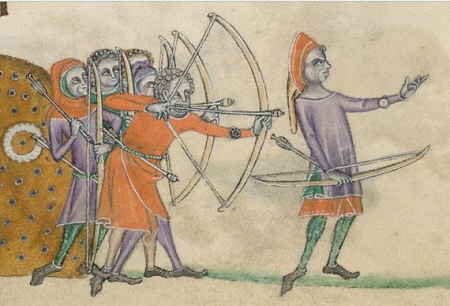
▲13th century
Bowmen. Young people were required to practise archery and
become proficient in their spare time and on Sundays and Holidays. |
|
John the son of
Roger the woodward of Chigwell says that when he was on his way in
the wood of Hainhault on the day of St. Thomas the Martyr in the
twenty-fourth year of the reign of king Henry, he saw seven men,
five with bows and arrows and two with with four greyhounds, of
whom three had masks, and he showed this to Roger, his father; and
the same Roger asked him if he recognised the men. He replied that
John le Blund of Edmonton was one of them. And he said he
recognised him because in the past year he often saw coming to see
his pigs which he had in the wood aforesaid for pannage. The
aforesaid Roger says that, so help him God, he suspects the
aforesaid John with regard to the forest of the lord King. |
|
ILLUSTRATED LONDON NEWS
Nov. 22 1851
Sketches in Hainault Forest

A hut in the
middle of Hainault Forest (1851) Pigs are feeding on acorns
in the autumn months. A forest right known as pannage. See
paragraph above ▲. |
|
1 bushel
of oats = 39 pounds. (17.7kgs)
1 quarter
of oats = 8 bushels (141.5kgs)
Price of
one sheep = 1 mark (13 shillings and sixpence)
Price of
oats ½ mark or 1 noble (6
shillings and eight pence)
A Noble coin was minted. A Mark coin was never
minted.
Henry III Short cross penny ►
|
 |
|
John, the
woodward of Lambourne, says that he suspects the parson of
Stapleford because he often saw him going with greyhounds in the
forest of the lord King
Simon the son of
Conis of Chigwell says that when he came at the dawn of St. Thomas
the Martyr to the house of his lord Richard the son of Peter in
Woodford for a quarter of oats and three sheep skins to take away
to London, and had reached the door of the aforesaid house, two
men came out with bows and arrows and seized him and made him
pledge faith that he would show nothing of them to anybody, and
that he would forthwith go the way that he first proposed to go;
and they followed him a full furlong saying to him that if he
returned they would punish him severely.
|
|

|
|
▲ Medieval Hunting Dogs
1. Alant or Mastiff (Swift and
follows scent) Ferocious, always muzzled. 2. Gazehound or
Greyhound (good sight and speed). 3. Lymer or Lymehound
(like a bloodhound).4 & 5. Brache or Rache (like a beagle). |
|
 |
|
▲ Fourteenth Century Berners and
Harbourers.
3. This is a Harbourer carrying a
horn, walking his Lymehound in the woods checking for scent of a
deer. The dog is kept on a cord.
1. This is a Berner. He has set his
dog free as it has unharboured a deer. (picked up the scent). He
has coiled the cord on his arm
2. This is also a Berner. He has
wide sleeves on his coat.
|
|
References:
Turner G.J. (1901) Select Pleas of
the Forest The Selden Society Publication XIII
Cox J.C. (1905) The Royal Forests of
England Methuen & Co.
Chapman. Colin (1995) How heavy, How
much and How long? Lochin publishing. |
 Hainault Forest Website